



Injectable Dermal Fillers Overview
 Restoring lost volume, softening deep lines, and refining your facial contours without surgery requires both expertise and care. At The Dermatology Institute of Boston, our board-certified dermatologists take a personalized, physician-led approach to every injectable filler treatment, evaluating your skin, health history, and goals before making any recommendations.
The demand for injectable dermal fillers has grown significantly over the years as individuals are discovering its benefits that extend to adults of all ages looking to turn back the clock, prevent aging, or redefine their contours.
Dermal fillers are medical grade gels that can be injected under the skin to improve the appearance of wrinkles, skin folds, under eye circles, and acne scars. They can also be used to make cheeks fuller and more youthful and to make lips plumper.
There are all different types of dermal fillers available. Some injectable fillers last a few months while others last several years. We believe dermal fillers are an effective facial treatment option to temporarily address concerns of volume loss, and can be adjusted gradually to address any volume-related facial changes that may arise down the line.
The best dermal filler for you will depend on a host of factors, including your specific goals, current skin condition, target area, and age. This is why our team at the Dermatology Institute of Boston utilizes a wide range of injectable fillers to make customized determinations that work best for our patients.
At the Dermatology Institute of Boston, we most often recommend hyaluronic acid fillers because they tend to be safer and are reversible if needed. The guide below walks through what to expect at your appointment, the options we use most frequently, and what makes our Boston dermatology team a trusted choice for injectable filler care.
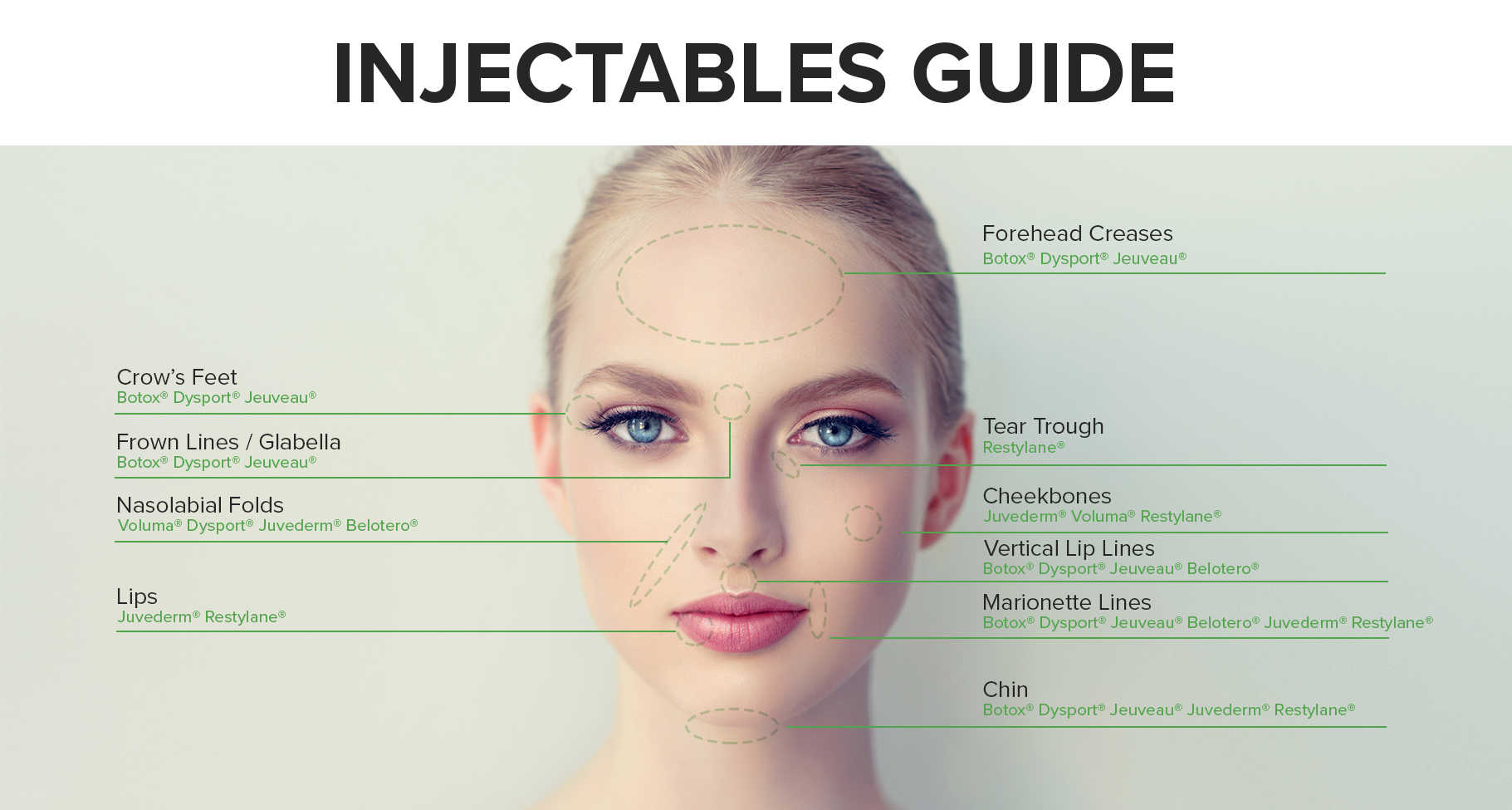
Dermal filler procedures can usually be done in just 15-30 minutes. A numbing cream may be used to make the procedure more comfortable, depending on the area being treated.
Following your appointment, some bruising and swelling in the treated area is normal and typically resolves within a few days. The lips and under-eye area tend to show more sensitivity than other parts of the face, and your provider will set clear expectations for your specific treatment areas.
Before your procedure, please let your provider know if you are taking any medications that affect blood clotting, such as aspirin, ibuprofen, or warfarin, as these can increase the likelihood of bruising or bleeding at the treatment site. Some supplements and vitamins may have a similar effect.
Injectable dermal fillers are a non-surgical cosmetic option that can address volume loss, smooth lines, and reshape or enhance specific facial features. The range of treatable concerns is broader than many patients realize:
Results from most fillers are temporary, with effects generally lasting from six to eighteen months depending on the specific product and treatment area. During your consultation, we will give you a clear picture of what to expect so there are no surprises.
Not all dermal fillers work the same way or serve the same purpose. Products vary in thickness, longevity, and intended application, and matching the right filler to the right area is an important part of achieving natural-looking results. At the Dermatology Institute of Boston, we work with the RHA, Juvederm, and Restylane product lines, selecting from these options based on a thorough review of your skin, anatomy, and goals.
As the range of injectable fillers has expanded, the selection process has become more nuanced. Our team takes the time to understand your history, needs, and treatment goals before making any recommendations. With a careful examination, your provider can make personalized suggestions that will yield the best results for you.
Injectable fillers made of hyaluronic acid (HA) are the most popular for several reasons. These dermal fillers are defined by their ability to create the most natural-looking results. Depending on the application points, they are incredibly effective at improving the appearance of fine lines and volume loss. Hyaluronic acid injectable fillers also provide the most flexibility compared to other forms of dermal fillers.
Hyaluronic acid is a naturally occurring substance in the body, making it extremely safe. Because of its biological nature, it can be reabsorbed into the body with little difficulty, generally between 6-12 months. For those who emphasize health and safety, this reason alone makes it the dermal filler of choice for most patients. With a simple application of hyaluronidase, the impact of an HA dermal filler can be reversed or reduced in certain areas if needed, providing an added layer of security and precision in refining outcomes.
For all these reasons, HA fillers are our preferred approach for most patients at our Boston practice. Below are the products we use most frequently.
This type of dermal filler is an incredibly adaptive and dynamic filler that moves with your face. It is often used to address dynamic wrinkles and folds.
Designed for lip augmentation, this option can be administered in less than 30 minutes. The lidocaine it contains dramatically reduces any discomfort associated with treatment.
This option is an effective dermal filler for the cheek areas of the face. This dermal filler reduces wrinkles and lines by restoring volume to the affected areas.
Designed to mimic the hyaluronic acid your body produces naturally, Restylane-L can correct moderate to severe wrinkles and lines. It is especially effective for addressing undereye hollows.
Restylane Lyft is well suited for restoring volume to the cheeks and mid-face, providing a subtle lift to areas that have flattened or hollowed over time.
This dermal filler can produce incredibly natural, dynamic results by using a smoother, smaller form of hyaluronic acid.
(video “Cheek filler” on The Dermatology Institute of Boston’s YouTube Channel)
For patients who prefer a more natural injectable option, PRFM treatment draws on growth factors from your own blood to rejuvenate the skin and support the under-eye area. Our dermatologists offer PRFM for patients interested in avoiding synthetic fillers entirely.
One of the longest-lasting dermal fillers, clients can see effects lasting for up to two years. While they are biodegradable, they are not naturally occurring in the body.
Also naturally occurring, this is a thicker consistency than hyaluronic acid fillers. CaHA injectable fillers do a fantastic job, specifically in adding volume, definition, and a plump appearance to areas such as the jawline and cheeks.
Certain CaHA fillers, such as Radiesse, are also referred to as biostimulatory fillers because they serve as a framework for new collagen development over time.
Dermal fillers are a strong option for many adults who are bothered by volume loss, deepening lines, or features they would like to refine without surgery. A consultation with one of our board-certified dermatologists is the most reliable way to determine whether a filler is the right fit for your goals, skin type, and health history.
Patients who tend to find fillers beneficial include those who have noticed hollowness beneath the eyes or in the cheeks, those bothered by persistent nasolabial folds or marionette lines, and patients seeking fuller lips or a more defined jawline. Fillers are also a frequent complement to other cosmetic treatments for patients interested in addressing both volume and movement-related lines at the same time.
Fillers are not the right choice for everyone, and our team will be straightforward with you. If another approach, such as Botox, microneedling , or a laser treatment, would better serve your skin and your goals, we will discuss that with you as part of your consultation.
When choosing where to receive injectable filler treatments, who performs the procedure and how that decision is made matters greatly. At The Dermatology Institute of Boston, filler treatments are administered by or under the direct supervision of board-certified dermatologists. This physician-led approach is central to how we practice.
Our dermatologists have been recognized as Boston Top Doctors and Castle Connolly Top Doctors, a reflection of the standing they have earned within the medical community. With a team that includes multiple board-certified physicians across specialties within dermatology, we bring collective expertise to every treatment decision.
We take the time to listen carefully and explain your options clearly. Our goal is not simply to perform a procedure but to help you understand what is possible, what is realistic, and what approach will serve your skin and your confidence best. Our offices in Boston’s Back Bay are designed to offer a welcoming, comfortable environment where you can feel at ease throughout your care.
Which types of dermal fillers are on the market?
There are several categories of dermal fillers currently available, including hyaluronic acid (HA) fillers, calcium hydroxylapatite (CaHA) fillers, poly-L-lactic acid (PLLA) fillers, and polymethylmethacrylate fillers.
At the Dermatology Institute of Boston, our dermatologists offer dermal fillers from Juvederm and Restylane, along with RHA® fillers and Radiesse®. Juvederm fillers include Juvederm XC®, Ultra XC®, and Voluma®, while Restylane fillers include Restylane-L®, Lyft®, Kysse®, Defyne®, and Refyne®.
During your consultation at The Dermatology Institute of Boston, one of our experienced dermatologists will describe our soft-tissue filler options in detail and recommend the product that best fits your needs.
How long do dermal filler results last?
The duration of a dermal filler’s results depends on several factors. These include the specific filler product administered, the amount of product injected, and the location where it is applied.
Generally, HA dermal fillers last anywhere from six to eighteen months. Radiesse®, a calcium hydroxylapatite filler, lasts from twelve to eighteen months. Fillers are gradually and safely absorbed into the body over this time. Patients often choose to come in for follow-up treatments in order to maintain their filler results.
In general, areas of the face with more movement, such as the lower face, break down fillers faster. Areas of the face with less movement, such as the tear troughs (under eye area) break down fillers more slowly.
Is there downtime after a dermal filler treatment?
Dermal filler treatments usually require little downtime. There may be some bruising and swelling but like any bruising or swelling, it will resolve with time. Some areas of the face, such as the under eye area, tends to bruise and swell more easily.
Which dermal fillers are used for lips?
At The Dermatology Institute of Boston, our dermatologists use Juvederm Ultra XC® or Resylane Kysse for lip enhancement. Both options improve the volume, definition, and shape of the lips in a way that supports natural-looking results.
Patients who want to achieve plump lips without surgery or implants find lip injections to be an excellent option. It’s often chosen by patients whose lips are thinner due to genetics or the aging process.
Before treatment, one of our board-certified dermatologists will meet with you to discuss your lip-enhancement goals and review your medical history. They will examine your face and assess factors like skin quality and the proportions between the lips and surrounding features. This assessment allows them to design a treatment plan that produces balanced, symmetrical results. The procedure itself typically takes around fifteen minutes or less.
Do dermal filler injections hurt?
Dermal filler injections in most areas of the face are only minimally uncomfortable, and generally, most patients tolerate the injections quite well. Some areas of the face, such as the lips, can be more painful, and a topical anesthetic or numbing cream may be used beforehand.
What is the difference between dermal fillers and Botox®?
There are numerous differences between dermal fillers and Botox® in terms of their composition, how they work, and what they are best suited to address. In general, fillers restore volume to the face, while Botox reduces the appearance of wrinkles by temporarily limiting muscle movement.
Most dermal fillers are composed of hyaluronic acid, a substance found naturally in the body. Botox®, on the other hand, is composed of botulinum toxin type A, which is derived from the Clostridium botulinum bacterium.
In general, Botox is most often used to treat lines on the upper part of the face such as: the glabella (between the eyebrows to treat “11” lines), the forehead and/or Crow’s feet (at the sides of the eyes). On the other hand, fillers are most often used to treat lines on the lower part of the face such as: the nasolabial folds (wrinkle between the edge of the nose and the outer corner of the lip), the marriott lines (fold from corner of lips to jaw), cheeks, tear trough (under eyes). Sometimes fillers can also be used to volumize or fill hollow temples.
Filler results also last longer than Botox® results. While most dermal fillers last for six to eighteen months, Botox® lasts for three to four months.
Do fillers make collagen over time?
Yes, all fillers have been shown to stimulate the body to make more of its own collagen. Some of the fillers, such as the hyaluronic acid fillers have proven that they stimulate certain cells of the skin, known as fibroblasts, to produce more collagen. Some of the fillers, such as Radiess®, are also referred to as biostimulatory fillers because they serve as a framework for new collagen development.
Do fillers migrate or move?
Fillers do not move far distances on the face such as from the cheek to the forehead or from the chin to the forehead. However, some fillers can shift slightly in the skin. This is most common if too much pressure is applied to the filler soon after it was placed in the skin. Most fillers are somewhat moldable for about a week after they are placed so patients are usually advised to avoid firm pressure to the area for the week or two after treatment.
Is there a more natural alternative to fillers?
Yes! Some patients prefer to avoid synthetic fillers and then choose to rejuvenate their face with platelet-rich plasma (PRP) or platelet-rich fibrin matrix (PRFM). These injectable fillers are created using the patient’s own blood and is rich in growth factors.
Can I combine dermal fillers with other treatments?
Many patients at The Dermatology Institute of Boston receive fillers alongside other cosmetic treatments. Fillers are frequently combined with Botox or other neuromodulators, with each treatment addressing a different aspect of facial aging. Fillers can also be scheduled alongside laser treatments, microneedling, or chemical peels. Your dermatologist will help you determine what combination, if any, makes sense for your goals and your skin.





















Dear Patients,
Our goal here at The Dermatology of Institute of Boston is protect the health of our patients and staff. To continue caring for our patients during these uncertain times, while strictly adhering to the guidelines set by the CDC, we will be only offering virtual consultations. For some patients, an in person visit is best, but if you feel that your concern could be addressed online, this may be a convenient option for you.